Bloomsbury is today one of London's more genteel and pleasant areas, an attractive place that draws tourists from around the world. The numerous Universities give the place a studious, academic atmosphere. Lovers of literature throng its squares, walking in the footsteps of Virginia Woolf, Lytton Strachey and W.B. Yeats. The more esoteric-minded visitor may be drawn to Bloomsbury because of the British Museum, and its consequent associations with Wallis Budge, MacGregor Mathers, Aleister Crowley and (again) W.B. Yeats.
A pleasant, scholarly neighbourhood. But one hundred years ago it had a very different reputation.
Recent research by Dr Jan Bondeson has found the entire area - from Euston station down to Russell Square tube - was thought of as the 'Murder Neighbourhood' par excellence.
[image:'Debra Arif', www.jtrforums.com]
During the 19th century, Bloomsbury's once well-to-do town houses had fallen into decay and disrepair. Converted into flats, they housed down-at-heel people, criminals, prostitutes - the area became known for its transient population. A series of gruesome murders - some unsolved - gained the area an unenviable reputation.
12 Great Coram Street (now Coram Street), 4 and 12 Burton Crescent (now Cartwright Gardens), 4 Euston Square (now Endsleigh Gardens) were all the sites of gruesome murders of women. (Why the preponderance of the numbers 4 and 12? No doubt a kabbalist might shed some light).
[image LEFT: www.flickr.com]
[image BELOW: creative commons]
Just as the name Rillington Place was changed to Ruston Close, in order to spare residents' embarrassment and shame, so too were several of these notorious street names altered.
Some of these addresses are no more, victims of the Euston Station redevelopment or of the expansion of local university buildings. Perhaps this is not a bad thing, since (we are told) "the murder house at 4 Euston Square kept its sinister reputation for decades to come: it was reported to be haunted, and strange groans and screams were heard...The bloodstain on the floorboards in the murder room could not be removed by any amount of scrubbing, and no dog would pass this room of horrors without snarling, whining and giving indications of intense terror."--Fortean Times no.318, Sep.2014 (p.46).
But 3 Bernard Street - where the unsolved murder of a young prostitute, Esther Praeger, too place in 1908 - still stands. It is very near Russell Square station and is now a souvenir, confectionary and tobacconists' shop.
Fortean Times no. 318 (September 2014) features an in-depth article by Dr Bondeson on Bloomsbury murders and their locations, and
his book Murder Houses of London (Amberley Publishing) will be published later in 2014.
The Ghosts of Senate House is one part of a creative research project led by Sarah Sparkes. It serves as an archive for uncanny, apocryphal stories emanating from Senate House. These stories formed part of "a Magical library for the 21st Century" an archive of writings, recordings, artwork, artefacts, and other contributions, which was first shown at the University of London as part of The Bloomsbury Festival October 2011.
Wednesday, 20 August 2014
Bloomsbury - Murder Neighbourhood
Thursday, 29 May 2014
1980s Memories of a Library Assistant
"For some reason I remembered my time as a library assistant at Senate House today so had a look on the web ... I came across your website. I worked there from 1983 - 1986. I think every library staff member had an experience of some kind - just like those on the blog. The Harry Price library was still there in those days and also Mr Wesencraft.
Here's some of my strange moments:
1. The first time I went to the Harry Price library I was accompanied by another staff member to show me around. Can't remember which book we were looking for but the first one I picked up was one by Harry Lorayne. My name is Lorraine. I told my colleague and she hurriedly found the book we went for and said we should get out! I also was in there once and books dropped on the floor. Everyone mentioned the chair in there that moved but I never saw that happen - Mr Wesencraft said it was only psychic forces and nothing to fear.
[the old HPL - Photograph by Tom Ruffles] I never minded going to the Harry Price Library when I knew Mr Wesencraft was in there – he was such a calm man and I was never afraid when he was there – used to be petrified going alone when he wasn’t.
2. As I remember - the art books were held on the 7th floor. I went up to 'fetch' (as it was termed) one and a very pleasant man in a grey suit with tidy white hair and beard came along the row I was in and said to me 'I am just going to cross your path'. I got my books and came back down in the lift. I went there later but he had gone. A few days later I was telling my colleagues about the nice man and I asked our boss who had been given a stack pass that day. It turned out that none were issued.
I remember the lift having problems - nobody liked going in that alone."
Mr Alan Wesencraft (1912-2007), or 'Wesey', was Honorary Curator of the Harry Price Library at Senate House. He was known to innumerable researchers as a helpful, kind and extremely knowledgeable man, who would guide people ably around the collection and its contents. He was introduced to later library staff as "the only man now working in the Library who met and worked with Harry Price".
Here's some of my strange moments:
1. The first time I went to the Harry Price library I was accompanied by another staff member to show me around. Can't remember which book we were looking for but the first one I picked up was one by Harry Lorayne. My name is Lorraine. I told my colleague and she hurriedly found the book we went for and said we should get out! I also was in there once and books dropped on the floor. Everyone mentioned the chair in there that moved but I never saw that happen - Mr Wesencraft said it was only psychic forces and nothing to fear.
[the old HPL - Photograph by Tom Ruffles] I never minded going to the Harry Price Library when I knew Mr Wesencraft was in there – he was such a calm man and I was never afraid when he was there – used to be petrified going alone when he wasn’t.
2. As I remember - the art books were held on the 7th floor. I went up to 'fetch' (as it was termed) one and a very pleasant man in a grey suit with tidy white hair and beard came along the row I was in and said to me 'I am just going to cross your path'. I got my books and came back down in the lift. I went there later but he had gone. A few days later I was telling my colleagues about the nice man and I asked our boss who had been given a stack pass that day. It turned out that none were issued.
I remember the lift having problems - nobody liked going in that alone."
Mr Alan Wesencraft (1912-2007), or 'Wesey', was Honorary Curator of the Harry Price Library at Senate House. He was known to innumerable researchers as a helpful, kind and extremely knowledgeable man, who would guide people ably around the collection and its contents. He was introduced to later library staff as "the only man now working in the Library who met and worked with Harry Price".
Labels:
Alan Wesencraft,
Harry Price,
Harry Price Library,
lift,
the stacks,
Tom Ruffles
Thursday, 25 October 2012
"Helpful" ghost in the stack
The eighth floor on Senate House Library continues to be associated with some strange goings on and we have recorded several uncanny stories emanating from this level.
Here is the latest story, from an anonymous member of staff, proving that once again the lifts of Senate House live up to their other-worldly reputation.
"Members of staff in the Library routinely go to fetch books/periodicals from the closed stack. The stack is the tower area of the Library occupying floors 8-19. In order to reach the stack you have to get into an old lift with a slam door. On this particular day I needed to fetch a book and a periodical on different floors. I went to the floor for the book first and left the printout for the periodical inside the lift. I then heard the sound of someone calling the lift so after I had got out on the 8th floor I closed the lift door so that the lift would be free for whoever called it. After I had fetched the book I called the lift back and was astonished to find the periodical plus printout waiting in the lift. This is not the sort of thing that another member of staff would do. I questioned any likely members of staff and no one said they had done it. I cannot offer any other explanation if this was not the case. (There was nothing remarkable about either of the titles which were fetched incidentally and the date was not onerous in any way)".
more ghost stories from The Stack:
What's up on the eight floor?
More eight floor weirdness
Sudden temperature drop - utterly discomposed
8th floor ghost?
Here is the latest story, from an anonymous member of staff, proving that once again the lifts of Senate House live up to their other-worldly reputation.
"Members of staff in the Library routinely go to fetch books/periodicals from the closed stack. The stack is the tower area of the Library occupying floors 8-19. In order to reach the stack you have to get into an old lift with a slam door. On this particular day I needed to fetch a book and a periodical on different floors. I went to the floor for the book first and left the printout for the periodical inside the lift. I then heard the sound of someone calling the lift so after I had got out on the 8th floor I closed the lift door so that the lift would be free for whoever called it. After I had fetched the book I called the lift back and was astonished to find the periodical plus printout waiting in the lift. This is not the sort of thing that another member of staff would do. I questioned any likely members of staff and no one said they had done it. I cannot offer any other explanation if this was not the case. (There was nothing remarkable about either of the titles which were fetched incidentally and the date was not onerous in any way)".
more ghost stories from The Stack:
What's up on the eight floor?
More eight floor weirdness
Sudden temperature drop - utterly discomposed
8th floor ghost?
Monday, 22 October 2012
Adventures of a Séance Table
![]() |
| The Slade Table - not as innocent as it looks! |
The Thanet Hotel stands at no 8 Great Bedford Street, just around the corner from Senate House. In 1876 a rather singular guest took up lodgings at this address - the notorious slate-writing medium Henry Slade.
![]() |
| no. 8 Great Bedford Street, 2012 |
Slade had been a celebrated medium in America, his home country, for at least 15 years and had arrived in London to prove his psychic powers. He gave many sittings at his Great Bedford Street residence and was pronounced by many of the notable Spirtualists of the day to be psychically gifted. Sittings took place in bright sunlight around a smallish table. Slade would place a slate underneath this table, later pulling it out into the sunlight to reveal scrawly writing across its surface - alleged communication from spirits of the dead.
Unfortunately Slade was not able to convince everyone of his powers and was eventually put on trial accused of faking the phenomena. For want of a more appropriate law with which to prosecute him, he was sentenced under the Vagrancy Act to three months' imprisonment with hard labour. After an appeal the conviction was overturned on a technical point and he was released on bail.
Slade returned to America, but his séance table remained behind where it was later acquired by non other than psychical investigator Harry Price.
Price describes how "the Slade table" was being used as an ordinary writing table at the offices of the London Spirtualist Alliance when he first came across it. Price went on to use the table in a series of so-called "controlled sittings" or séances on "the electric girl", a young dental nurse and alleged medium named Stella Cranshaw.
In 1925, Price's book reporting the findings - "Stella C. An Account of Some Original Experiments in Psychical Research" - was published. The Slade table's rather violent psychical activity at many of the sittings is documented in detail in this book.
The table appears to take a particular dislike to a certain Colonel Hardwick, present at many of the sittings, physically attacking him to the point of actual bodily harm.
Here is the Colonel's own report of his encounter with the Slade Table:
"The table tipped towards me as usual...It began to hammer on my knees until the blows became painful and I consequently removed them, expecting the table to crash to the floor. My knees were red from the blows...To my surprise the table did not go beyond the position where my knees would have been, but it made one or two smart blows as of to ensure that they had been removed."
If anyone knows the whereabouts of the Slade table today, please do get in touch - there are plenty of 'Colonels' in need of correcting!
Wednesday, 21 December 2011
Who called the lift?
Mick Lucette is the Building Services Manager at Senate House.
Mick witnessed a mysterious, cloaked figure, moving on the stairs ahead of him, as he made his way towards a lift in the building.
The same lift has been linked to sightings of what is assumed to be Sir Edwin Deller’s ghost.
You can hear Mick recounting his story here:
Saturday, 29 October 2011
Glowing figure in doorway of Senate Room

The photographer was sure that the room was empty at the time; subsequently - examining the resulting image - they realized that a mysterious luminous figure could be seen in the doorway at the far end of room.
Is this the Blue Lady? Or a reappearance of the Time Warrior from the Tom Baker-era Dr Who?
Tuesday, 6 September 2011
Enigmatic manifestation in Senate House lavatory
A Senate House member of staff reports the following anomalous experience; they were leaving work and descending a staircase one evening in mid-June 2011:
" ...there's a ladies loo on that floor so I decided to use it. The stairs were quite quiet but you could tell there was a function going on in the vicinity from distant chatter. Not too close like floor below but somewhere in the building or perhaps Stewart House.
When I entered the loo, standing by the window to put my rucksack down I could hear there was some that function going on again which confirmed it for me. Voices were a distant murmur. You could tell they were adjacent to the loo.
As I exited the loo there was a huge, long, loud belly laugh from something in front of me and directly in my face and very close to me like someone standing immediately in front of me. The voice was far louder than the distant voices I heard by the window and far above the flushing sound of the loo as well. I couldn't see anything. It was almost deliberate as if having waited for me to exit the loo. I froze to the spot and was gripped with confusion.
There was clearly an invisible woman laughing loudly. I could even detect an accent as there intermittent mumbling (I feared curses actually). It was accented like the Gypsies that used to sell me flowers as a child. I became very hot as my face was quite red and sweaty from the panic of trying to work out where the voice was coming from and my stomach was in knots. The sound lasted no longer than 15 seconds and died away. I could then only hear the din from the party/conference by the window.
I convinced myself it was just a sound from the party/conference and began to wash my hands. As I was washing my hands the voice started laughing again behind me and then echoed around the room up to the ceiling and into the other toilet. There are two toilet cubicles. The door was open in the other loo so no one can hide in there. It was like someone using the Tannoy system to laugh but not that microphone sound just loudly projecting their voice.
The laugh started with huge volume and died down to tittering echoing around. I ran outside the loo to see if it was one of the cleaners and down to 2nd Floor toilet to see it there were any women or a single woman in there, there was no one around so no one was playing a trick on me. Was definitely odd as it was so close it could only be coming from inside the room.
The next evening around 5.30pm I used the same toilet again and heard a woman laughing. At first I thought it was the same thing happening again but this time I heard a second voice and could tell voices were coming from the floor below. I was then able to compare the sounds which convinces me that the first experience was closer and louder, almost in my ear and the 2nd was distant."
Question: Do Romany spirits haunt the building? And - if so - why?
Sunday, 24 July 2011
More 8th floor weirdness
Regular readers of this blog may recall previous posts click here and here outlining some Library staff's odd experiences on the 8th floor of Senate House.
There have recently been reports of further incidents, although of a rather indeterminate nature. The current writer was, a few weeks ago, fetching books from the same room. As the only person in the stacks at the time, all was quiet. Even the famous Senate House howling wind was absent. Upon exiting the room, a very slight but definite touch of the hair on top of the head was felt, akin to walking through a cobweb. Upon re-examination of the doorway, no cobwebs were to be found. The 'presence' (if that is what it was) did not give an impression of being threatening or sinister, merely curious.
Another staff member reports fetching books on an adjacent floor recently, and hearing a loud, repeated clicking sound coming from this same 8th floor room. Again, there was no one else present - the person concerned had verified this to be the case.
Riddle: What makes a clicking sound and touches peoples' hair?
There have recently been reports of further incidents, although of a rather indeterminate nature. The current writer was, a few weeks ago, fetching books from the same room. As the only person in the stacks at the time, all was quiet. Even the famous Senate House howling wind was absent. Upon exiting the room, a very slight but definite touch of the hair on top of the head was felt, akin to walking through a cobweb. Upon re-examination of the doorway, no cobwebs were to be found. The 'presence' (if that is what it was) did not give an impression of being threatening or sinister, merely curious.
Another staff member reports fetching books on an adjacent floor recently, and hearing a loud, repeated clicking sound coming from this same 8th floor room. Again, there was no one else present - the person concerned had verified this to be the case.
Riddle: What makes a clicking sound and touches peoples' hair?
Monday, 18 July 2011
Who is the Blue lady?
| The Senate Room during a presentation by Blue Firth at Hostings 4 |
Of all the ghosts stories from Senate House, the story of the Blue Lady is perhaps the most intriguing and mysterious. She is said to appear in the Senate room, one of a suit of rooms which once served as a meeting place for the governing bodies of the University - the Court and the Senate. These wood panelled rooms are heavy with a smell that could be described as academic incense. Paintings of notable academics line the walls. Interestingly the portraits are all of men apart from one solitary painting of Queen Victoria in a pale blue dress!
The Senate room has been used as a venue for the GHost Project (led by Sarah Sparkes and Ricarda Vidal) for the Hostings events - interdisciplinary presentations and performances exploring the roles of ghosts in contemporary society.
The following account of the Blue lady was sent to us by Ricarda Vidal:
The Blue Lady
"A member of staff of UoL conferences told me that when you walk into the Senate Room coming from the Jessel Room and look towards the far left corner you can make out the shape of a lady clad in blue sitting in one of the booths. When approached the apparition would dissolve. She had never seen the blue lady but colleagues of hers had and she herself had experienced a sudden drop in temperature when passing by close to the spot where the lady had appeared. I decided to investigate the room which I had planned to book for a workshop. It was a cold day in November and by the time I’d made it to the room it was already dark outside. The heating was turned to its maximum and the old wood panelling creaked and groaned. I looked to the far left corner, but couldn’t see anything, just rows of empty seats. As I walked towards the spot I found myself looking forward to the promised sudden drop in temperature: despite the high ceilings and the spaciousness of the room it was stuffy and I would have been grateful for a gust of cold air. But nothing happened. I took a photograph of the corner, which I’m sending you. I can’t see anything on it, but perhaps you can."
![]() |
| The Blue Lady's corner - Photograph by Ricarda Vidal |
Friday, 1 July 2011
Tom Ruffles remembers the old HPL
Tom Ruffles has posted a fascinating and informative account on his blog detailing his memories of the Harry Price Library when it was still possible to access the contents of this unique archive together in one location. Tom was a regular visitor to the Harry Price Library (HPL) in the late 1980s and early 1990s when he was undertaking a part-time psychology degree at Birkbeck.
Here are some extracts from Tom's reminiscences:
"The space occupied by the HPL had a cosy feeling (or perhaps that is nostalgia giving it a glow). The wind used to whistle round, which was atmospheric. There was a good view but there was never time to spare for looking out of windows. Sometimes there would be other people working at the small tables and I seem to remember there was only space for three people at any one time. The rest of the floor was very quiet, seemingly unvisited. I remember going for a walk around the deserted stacks, finding it creepy and unnerving in the semi-darkness"
"The librarian in charge of the HPL, Alan Wesencraft, was extremely welcoming and helpful Alan, or Wesey as he was generally known, had actually retired in 1977 and worked only part-time as the HPL’s Honorary Curator, so eventually I, like other regulars, was given a card that enabled me to ask for the key if he was not there and travel up to the HPL where I would work unsupervised and often alone"
"Despite the cramped environment everything was well organised. There was always a huge feeling of serendipity when browsing the shelves, not knowing what might turn up. You felt like a small child in a toyshop, wanting to see everything as quickly as possible, unable to decide what to look at first, knowing you could spend years in there and only scratch the surface. In addition to the shelves of books there were film canisters on the window ledges, and filing cabinets with photographs, correspondence and clippings. One cabinet housed Eric Dingwall’s files, now sadly embargoed but then freely available to researchers. Had I realised that they would become inaccessible I would have made more use of them when I had the opportunity."
"Sitting in the room, there was a sense of continuity with the past, and one could feel that Harry Price himself might put his head round the door to see how you were getting on, and tell you about the collection of which he was so justifiably proud."
You can read more about Tom Ruffles memories of the old HPL on his blog HERE
Tom Ruffles is Hon. Review Editor, Journal of the Society for Psychical Research and author of "Ghost Images: Cinema of the Afterlife"
Read more about the SPR HERE
Here are some extracts from Tom's reminiscences:
"The space occupied by the HPL had a cosy feeling (or perhaps that is nostalgia giving it a glow). The wind used to whistle round, which was atmospheric. There was a good view but there was never time to spare for looking out of windows. Sometimes there would be other people working at the small tables and I seem to remember there was only space for three people at any one time. The rest of the floor was very quiet, seemingly unvisited. I remember going for a walk around the deserted stacks, finding it creepy and unnerving in the semi-darkness"
![]() |
| The Old Harry Price Library Photograph by Tom Ruffles |
"The librarian in charge of the HPL, Alan Wesencraft, was extremely welcoming and helpful Alan, or Wesey as he was generally known, had actually retired in 1977 and worked only part-time as the HPL’s Honorary Curator, so eventually I, like other regulars, was given a card that enabled me to ask for the key if he was not there and travel up to the HPL where I would work unsupervised and often alone"
![]() |
| Another view of the old HPL - Photograph by Tom Ruffles |
"Sitting in the room, there was a sense of continuity with the past, and one could feel that Harry Price himself might put his head round the door to see how you were getting on, and tell you about the collection of which he was so justifiably proud."
You can read more about Tom Ruffles memories of the old HPL on his blog HERE
Tom Ruffles is Hon. Review Editor, Journal of the Society for Psychical Research and author of "Ghost Images: Cinema of the Afterlife"
Read more about the SPR HERE
Sunday, 12 June 2011
Recording a spirit

Output Arts have recently been considering ghost stories, how they relate to a sense of place and why people look for ghosts. As an artistic collective, we make audiovisual installations specifically for non-gallery venues that link in some way to the space in which they are shown. Thus, the theme of the Ghosts of Senate House project particularly interested us in its focus on a particular place.
Much of our interest lies in the recording aspect of ghost hunting: the setting-up of equipment in the hope of "capturing" a ghost on tape. There is a strong desire to prove the presence of something that is really about absence; the absence of someone who was once alive and present in that space. Recording interests us as our work largely involves recording audio to compose into pieces that provoke consideration of an idea. In a sense, all recordings are ghosts - reflections of something or someone that was in that place at that moment.
For the Ghosts of Senate House project we have been particularly considering the sense of place and how a place can have a character or feeling. We hope to record this "spirit of place" in audio form for a number of different spaces in Senate House that relate to hauntings and turn these into audio sculptures that will allow the listener to consider the character of sound and how this can evoke a particular feeling.
The Goetia of Senate House by Magick Concrète.
About Magick Concrète
Magick Concrète is a collaboration between Andy Sharp (English Heretic) and Mark Pilkington (Strange Attractor), the moniker a word play on "real music" - extending the concept to the practice of reel-to-reel magic. Combining interactive pilgrimage, with the subsequent and ceremonial manipulation of found sounds and narratives.
The Goetia of Senate House by Magick Concrète.
A shared aural experience of people who visit or work at Senate House is a howling sound, heard in various areas of the building. For Magick Concrète's contribution to The Ghosts Of Senate House project, we will attempt to investigate the imaginative significance of this phenomenon, drawing together Renaissance theurgic philosophy, the use of oral history, archetypal readings of the genii loci, and avant garde tape processing practices.
When first told of the phenomenon what immediately connected with us, was its relation to the word Goetia. Goetia is a form of medieval spirit communication, etymologically, it is speculated, derived from the word 'to howl'. On the surface, and somewhat glamorously, Goetic theurgy purports to practice the summoning of a host of 72 spirits, though a more subtle reading of the system suggests that these spirits are all around us, and conversation with them is less achieved by direct invocation, than communication, apprehension of, or simple noticing of their presence.
In many ways rapport with the spirits of the Goetia relates to conversing with the genii loci of a given place. The genii loci, a term from antiquity, is traditionally considered to be the protective spirit of a particular building or environment, though a more open ended interpretation, might be to consider it the governing atmosphere. Less a deity, more a collection of feelings, intuitions and experiences of a place.
The Goetic theurgist would attempt to capture these spirits in brazen vessels and the grimoires describing this form of magic gave instructions for the fashioning of these receptacles. The analogy with the genie in the lamp of Arabian lore is no coincidence; much of the practice being disseminated in folklore by the tales of the Arabian nights. For our project we will use modern recording media as the means of trapping the genii loci – if one considers a tape recorder to be a technological analogue of the genie's lamp, then the metaphor is obvious and natural.
The legions of Goetic spirits speak a language that is pan-cultural; in other words conversing with them is a means of identifying archetypal experiences. For our practice we will use oral history evidence to create sound recordings which we will process using the techniques of musique concrète to create what we hope is an aesthetic yet tangible spirit of Senate House. Senate House itself as the instrument through which the genii loci communicates.
Our results will be presented in concrete form as a sound installation housed within a listening apparatus – a means for the listener to hear and intuit their own sense of the spirit of the place.
Magick Concrète is a collaboration between Andy Sharp (English Heretic) and Mark Pilkington (Strange Attractor), the moniker a word play on "real music" - extending the concept to the practice of reel-to-reel magic. Combining interactive pilgrimage, with the subsequent and ceremonial manipulation of found sounds and narratives.
The Goetia of Senate House by Magick Concrète.
A shared aural experience of people who visit or work at Senate House is a howling sound, heard in various areas of the building. For Magick Concrète's contribution to The Ghosts Of Senate House project, we will attempt to investigate the imaginative significance of this phenomenon, drawing together Renaissance theurgic philosophy, the use of oral history, archetypal readings of the genii loci, and avant garde tape processing practices.
When first told of the phenomenon what immediately connected with us, was its relation to the word Goetia. Goetia is a form of medieval spirit communication, etymologically, it is speculated, derived from the word 'to howl'. On the surface, and somewhat glamorously, Goetic theurgy purports to practice the summoning of a host of 72 spirits, though a more subtle reading of the system suggests that these spirits are all around us, and conversation with them is less achieved by direct invocation, than communication, apprehension of, or simple noticing of their presence.
In many ways rapport with the spirits of the Goetia relates to conversing with the genii loci of a given place. The genii loci, a term from antiquity, is traditionally considered to be the protective spirit of a particular building or environment, though a more open ended interpretation, might be to consider it the governing atmosphere. Less a deity, more a collection of feelings, intuitions and experiences of a place.
The Goetic theurgist would attempt to capture these spirits in brazen vessels and the grimoires describing this form of magic gave instructions for the fashioning of these receptacles. The analogy with the genie in the lamp of Arabian lore is no coincidence; much of the practice being disseminated in folklore by the tales of the Arabian nights. For our project we will use modern recording media as the means of trapping the genii loci – if one considers a tape recorder to be a technological analogue of the genie's lamp, then the metaphor is obvious and natural.
The legions of Goetic spirits speak a language that is pan-cultural; in other words conversing with them is a means of identifying archetypal experiences. For our practice we will use oral history evidence to create sound recordings which we will process using the techniques of musique concrète to create what we hope is an aesthetic yet tangible spirit of Senate House. Senate House itself as the instrument through which the genii loci communicates.
Our results will be presented in concrete form as a sound installation housed within a listening apparatus – a means for the listener to hear and intuit their own sense of the spirit of the place.
Friday, 3 June 2011
What's up on the 8th floor?
We have already posted several stories telling of strange occurrences on the 8th floor of Senate House Tower. Many who work in the bookstacks report that this floor makes them feel downright uncomfortable. (The bookstacks are the many floors of library books and archives that belong to the University of London.)
The north side of the 8th floor used to house part of the Harry Price Archive.
Access to Senate House Tower, where the bookstacks are housed, used to be via a lift the size of and telephone box, known as 'the Coffin'.
![]() |
| Helen Duncan under investigation on 'the Séance Chair' |
Stefan Dickers was cataloguing the Harry Price Archive between May 2004 – May 2005. Stefan admitted that it always made him feel uncomfortable up on the 8th floor and indeed it is considerably colder than other parts of the building. He explained how the room was full of boxes, piles of pamphlets and letters, shelves of books and even test tubes from the laboratory of psychical research. The séance chair, used by Price when testing the authenticity of mediums such as Rudi Schneider and Helen Duncan, was placed at the end of a corridor. In another corner stood a large chest containing the magic lantern slides Price used in his lectures. It all sounds amazing and I find myself somewhat envious of this job and being surrounded by so many curious and interesting items including Dirty Dings Filing System (more on that later).
However it was, as with most of our contributors' ghostly stories, in the south part of the 8th floor that Stefan experienced a moment of sheer terror.
Stefan described how whilst he was shelving some books he heard the sudden and violent sound of a book being thrown onto the floor and travelling with some speed past him. He couldn't wait to leave the 8th floor. In those days the bookstacks were lit individually, each light had to be turned off behind one on leaving the room. This made for a dark and shadowing atmosphere added to by the darkening winter night outside the window. To make matters worse Stephan had to make the long journey in the dark alone using 'The Coffin' to make his escape.
You can read more about Stefan's experience here
and another account of the presence stalking the bookstacks on the eight floor here
Saturday, 14 May 2011
Return of the Lost Rivers
| 'The Moat' - could one of London's Lost Rivers be attempting to fill it up? |
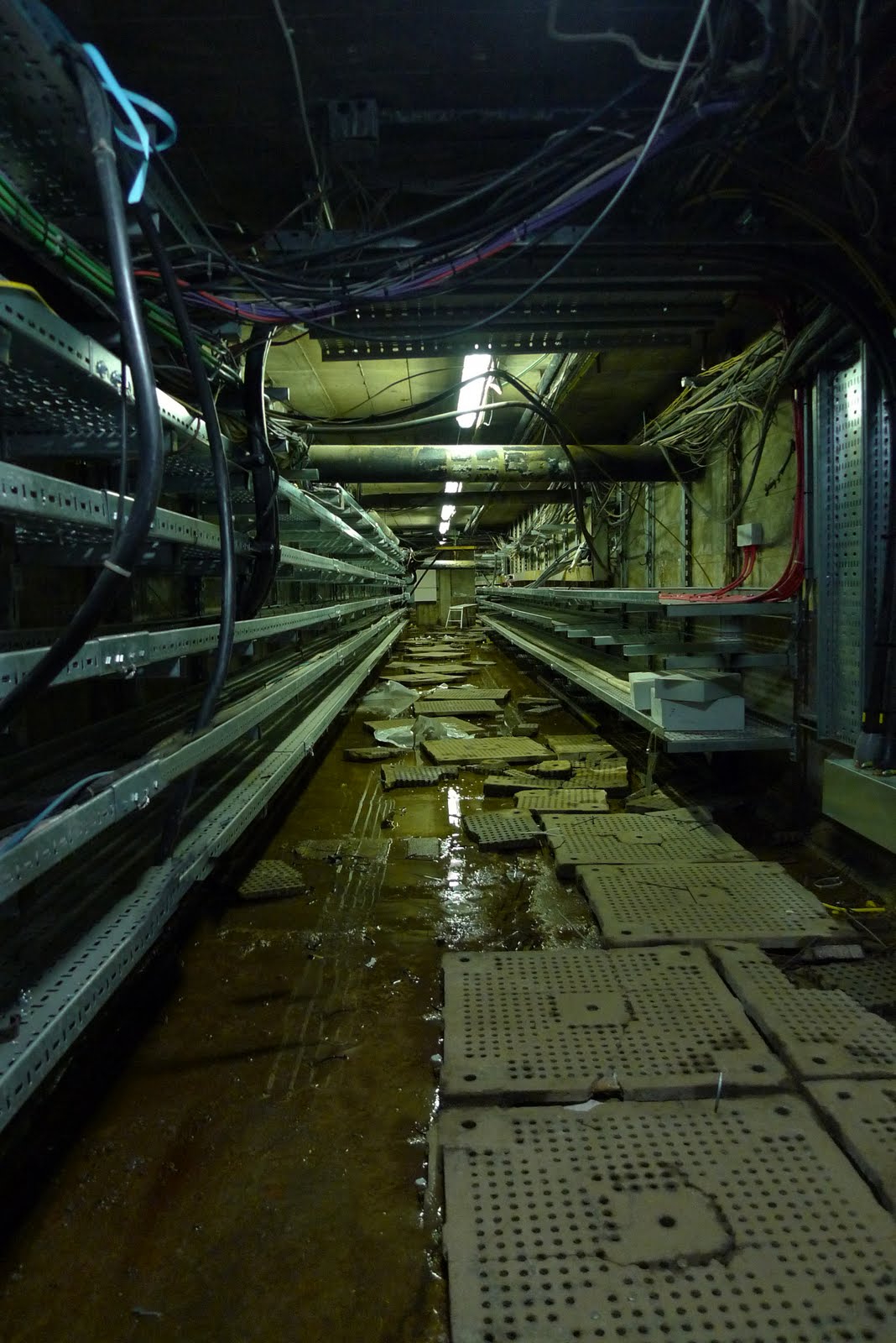
Several stories are circulating about the existence of a pond, lake or well beneath the foundations of Senate House. John Stone, Building Services Technical Officer at Senate House, was able to shed light onto the possible origins of these watery tales when he took me on a tour of the subterranean world beneath North Block.
Our tour began above ground on North Block Green, a grassy square overshadowed by Senate House and SOAS buildings; here John took me to look over the side of ‘the Moat’ a sunken, tile-lined gully built to bring light into the basement levels of the building. At the bottom of ‘the Moat’ and going unseen by most is a surprisingly fast flowing stream of clear water!
.
.
“There has always been a bit of water here” John explained, going on to say that in recent years the amount has significantly increased, ebbing and flowing with the seasons, the water decreasing towards the end of the summer. John told me that tests show only trace elements of chlorine and other Thames Water chemicals making it doubtful that the source is a leaking water main.
.
Geologists, employed to investigate the water, suggest that a spring up to a mile away has been diverted by building work however, this does not account for the fact that the water has been present to a greater or lesser extent since the buildings construction. I speculate that this water may originate from one of the lost rivers of London, possibly the Fleet. John agrees that there may be some truth in this citing that recent excavations of North Block Green unearthed an old conduit.
Next, we descended below ground into ‘The Moat’ itself.
.
Geologists, employed to investigate the water, suggest that a spring up to a mile away has been diverted by building work however, this does not account for the fact that the water has been present to a greater or lesser extent since the buildings construction. I speculate that this water may originate from one of the lost rivers of London, possibly the Fleet. John agrees that there may be some truth in this citing that recent excavations of North Block Green unearthed an old conduit.
Next, we descended below ground into ‘The Moat’ itself.
This tunnel runs all the way from the British Museum to Torrington Square, but is mostly inaccessible due to the current building works at the university. As we travelled further along the tunnel the sound of running water grew louder until finally we descended another ladder into a deeper tunnel from where the sound was emanating. An extraordinary and haunting sight met my eyes - for here, beneath Senate House, was a large pool of water.
Water is flowing through a fissure in the wall and collecting on the floor. The duck boards dotted along the tunnel serve as stepping stones and were placed there when the building was first constructed showing that the water was always present. A channel two inches by two inches has been carved into the stone floor to allow the water to flow into a sump pumping the water up to The Moat above.
![]() |
| What lies beneath Senate House |
Below Senate House, water is flowing in from some mysterious source. The water is constantly pumped out to prevent serious flooding. The pump keeps going and the water keeps coming back, but where is it coming from?
Please note: These tunnels are not open for public access. Access was granted under special circumstances and the correct safety procedures were adhered to.
Saturday, 30 April 2011
The ghost of Emma Louise

A couple of minutes walk from Senate House is Arthur Tattersall House at 119 Gower Street - one of the many fine Georgian buildings on this street. It is now owned by University College London, and is used for student accomodation.
In 2004, the PARANORMAL DATABASE was contacted regarding the legend of a young girl called Emma Louise who was said to have been killed in a tunnel which is supposed to run between the more modern UCL building and the older Cruciform building. The legend was that if Emma Louise's name was repeated 3 times, she would appear. The informant, a former student resident of 119 Gower Street, stated that they and their friends had been very sceptical about this, but did performed the 'invocation' for a laugh.
Shortly after this, they claimed, they began to hear a young girl's laughter, which was repeated intermittently all night. The students searched everywhere, but could find no explanation for the sound.
Disturbed by this turn of events, they moved into a friend's room for the night, but could still hear the laughter. Eventually it stopped, but suddenly, about an hour later, they heard a bang as if someone had thrown themselves against the door - naturally, there was no-one there.
These noises were repeated on another night, with the same laughter, once again, the frightened students left the room - but when they returned, they found the door to be locked, even though they had left it open. A spare key was obtained, and there, written on the wall in large letters were the words: "HELP ME!", "DIE", written twice in two different parts of the wall. Elsewhere the word "MURDER" had been written on the wall, as was "R.I.P", besides which was a child's drawing of a person with a sad-looking face.
One of the students rubbed the word "MURDER" off the wall (it having been written in chalk or crayon). They again left the room for a brief moment, but when they returned, where "MURDER" had been written, there was a large kitchen knife balanced on the beading of the wall.

Labels:
119 Gower Street,
Emma Louise,
Gower Street,
tunnel,
tunnels,
UCL
Thursday, 28 April 2011
Book-throwing ghost?
A former Library colleague reports having undergone a frightening experience whilst in the Senate House bookstacks. Some years ago, he was alone on the 8th floor, and had to look for a book in the room at the southern end of the floor. It was quiet and still. Bending down to the bottom shelf to locate the book, he was startled to hear a sudden noise behind him, as a book scudded along the floor, landing close by. It had, apparently, been thrown across the room – but by whom?
Alarmed - since he knew there to be no-one else on the 8th floor at the time - he did not linger, but grabbed the book he had been searching for, and quickly left the room without further delay.
[NB: this is the same room where a similar event was reported... CLICK HERE ]
Alarmed - since he knew there to be no-one else on the 8th floor at the time - he did not linger, but grabbed the book he had been searching for, and quickly left the room without further delay.
[NB: this is the same room where a similar event was reported... CLICK HERE ]
Labels:
8th floor,
Senate House,
Senate House Tower,
The Tower
Wednesday, 20 April 2011
John! There’s someone up there!
“John! There’s someone up there!” “If you go into the head end, right, and look at what’s happened. The lights get switched on!”
This was directed to John Stone the Building Services Technical Officer. John was taking me on a tour of Senate House and we were at that time exploring the basement to investigate stories of lakes and wells rumoured to be located beneath the building (more on that later).
The concerned voice came from inside a room in the out-of bounds section of the basement which is currently undergoing building works. We entered the room and found a group of subcontractors on a break. The subcontractors explained to us that for the past six weeks or so, at each morning, the lights on the 12th and the 15th floors have come on by themselves.
The 12th and 15th floors are used to store library books and the floors are secured at the end of every day by the library staff. Presence detectors are installed on these floors; these are designed to turn the lights on if a large enough mass moves in front of their sensor beams.
The lights come on at , but no one is there; this has obviously perplexed the night staff somewhat. One subcontractor was interested to find out what books were stored on those floors and I’m rather curious about this myself.
![]() |
| Senate House - if you're passing by at 3am, look up to the 12th and 15th floors to see the lights come on by themselves! |
Sunday, 17 April 2011
The Field of the Forty Footsteps
A curious legend is associated with the immediate surroundings of Senate House - the tale of the Field of the Forty Footsteps. During the 17th and 18th centuries, the fields situated due north of Montague House (whose site is now occupied by part of the British Museum), were known as a place of ill-repute. This location - first known as the Long Fields, and latterly as Southampton Fields - was notorious as a meeting-place for duellists.
Legend has it that, at the time of the Duke of Monmouth’s rebellion (1685), two brothers were besotted by the same lady, who refused to choose between the two of them. Opting to fight for her affections at the traditional duelling ground of Southampton Fields, the unfortunate pair were both mortally wounded, and died there. It was said that the exact location of their duel could still be observed many years later, since the grass would not grow on those spots where their feet had trod during their deadly contest.
“The footsteps were in the middle of the field, and forty in number, and...were each imprinted by the approach and struggle of two combatants, who had fought, and perished there, in the dead lock of mutual hatred.” [Coming Out; and The Field of the Forty Footsteps (in 3 volumes), Jane and Anna Maria Porter, London: Longman, Rees, Orme, Browne & Green, 1828 (vol.3, p.5)]
A letter addressed to the poet Robert Southey (1774-1843), from his friend John Walsh, encouraged Southey to visit the Fields:
“I think it would be worth your while to take a view of those wonderful marks of the Lord’s hatred to duelling called ‘The Brothers’ Steps.’ They are in a field about a third of a mile northward from Montague house...The prints of their feet are about the depth of three inches, and nothing will vegetate them so much as to disfigure them...Mr George Hall, who was the Librarian of Lincoln’s Inn, first showed me these steps twenty-eight years ago...he remembered them about thirty years, and the man who first showed them to him about thirty more, which goes back to the year 1692...My mother well remembered their being ploughed up and corn sown to displace them, about fifty years ago, but all was labour in vain, for the prints returned in a while to their pristine form...” [Southey's Common-place book, Second series, Special Collections, Robert Southey (edited by John Wood Warter), London: Longman, Browne, Green & Longmans, 1850 (‘Curse of Duelling’, pp.20-21)]
Southey went in search of the footsteps and found them:
“about three-quarters of a mile of [sic] Montagu House, and about five hundred yards east of Tottenham Court Road. The steps answered Mr Walsh’s description. They are of the size of a large human foot, about three inches deep, and lie nearly from north-east to south-west...the place where one or both of the brothers are supposed to have fallen is still bare of grass. [We also saw] the bank where (the tradition is) the wretched woman sat to see the combat.” [Ibid, (p.21)]
In the early twentieth century, the writer and Spiritualist Jessie Adelaide Middleton investigated the legend, and believed that she had established the precise location of the mysterious footsteps. In her collection ‘Another Grey Ghost Book’ she wrote:
“I often wonder if those who sleep calmly and peacefully in the quiet lodging-houses of Torrington Square ever guess that the ground over which they are sleeping was once the scene of a desperate tragedy...As regards the exact locality, I have taken great pains to confirm it, and from various sources have ascertained that no doubt it covered what is now Torrington Square...” [Another Grey Ghost Book, Jessie Adelaide Middleton, London: E. Nash, 1914, (pp.49-60)]
The footprints may still be observed by the curious (and imaginative) visitor. Just north of Senate House and in front of Birkbeck College, is a recently re-designed ‘piazza’, still bearing its original name of Torrington Square. Is it mere co-incidence that the four grassed areas, newly planted, already have distinct bare patches the size of footsteps?
Labels:
duelling,
Field of the Forty Footsteps,
footprints,
Long Fields,
The Brother's Field,
Torrington Place
Thursday, 14 April 2011
Sudden temperature drop - utterly discomposed
Another account of a mysterious drop in temperature and feelings of extreme unease in Senate House Library:
"The details are lost to the mists of time since this happened more than a year ago, but one day I was up in the Stack looking for a book. It was light outside and temperate inside, ideal (i.e. reassuring) conditions for being in the usually creepy Stack. As I was crouching for the book, it suddenly became cold, but there was no draft – just a drop in temperature. I also remember the silence started to roar in my ears in a rather eerie and persistent fashion. These two occurrences served to discompose me utterly and instil in me an urgent need to skedaddle out of there as soon as possible. I am happy to report however that the ‘presence’ in question (if it wasn’t just my nerves) took pity on me and did not make an appearance – for surely if it had, there would soon thereafter have been a death (from fright) in Senate House and perhaps another ghost to add to the collection."
Tuesday, 12 April 2011
8th floor ghost?
"I was working late until 6.30 earlier this year and had to fetch from the Stack. One of the items on my list was on the 8th floor. I approached the relevant section; suddenly I felt the temperature drop and I began to feel uneasy. I thought maybe I was imagining it, but when I looked up the book I saw that the book in question was about ghost stories. I decided to take the book and leave as quickly as possible. As I was leaving, I glanced through the lift door and noticed that a light had come on near to the section where I had been. The lights are motion sensitive and there had been no one else up there. I told a colleague about this at a later date and we tried to find the book on the catalogue but had no success."
Labels:
8th floor,
cold,
Senate House,
Senate House Tower,
The Tower
Subscribe to:
Posts (Atom)