Pages

The Ghosts of Senate House is one part of a creative research project led by Sarah Sparkes. It serves as an archive for uncanny, apocryphal stories emanating from Senate House. These stories formed part of "a Magical library for the 21st Century" an archive of writings, recordings, artwork, artefacts, and other contributions, which was first shown at the University of London as part of The Bloomsbury Festival October 2011.

Sunday, 24 July 2011

More 8th floor weirdness

Regular readers of this blog may recall previous posts click here and here outlining some Library staff's odd experiences on the 8th floor of Senate House.


There have recently been reports of further incidents, although of a rather indeterminate nature. The current writer was, a few weeks ago, fetching books from the same room. As the only person in the stacks at the time, all was quiet. Even the famous Senate House howling wind was absent. Upon exiting the room, a very slight but definite touch of the hair on top of the head was felt, akin to walking through a cobweb. Upon re-examination of the doorway, no cobwebs were to be found. The 'presence' (if that is what it was) did not give an impression of being threatening or sinister, merely curious.


Another staff member reports fetching books on an adjacent floor recently, and hearing a loud, repeated clicking sound coming from this same 8th floor room. Again, there was no one else present - the person concerned had verified this to be the case.


Riddle: What makes a clicking sound and touches peoples' hair?

Monday, 18 July 2011

Who is the Blue lady?

The Senate Room during a presentation by Blue Firth at Hostings 4
Of all the ghosts stories from Senate House, the story of the Blue Lady is perhaps the most intriguing and mysterious.  She is said to appear in the Senate room, one of a suit of rooms  which once served as a meeting place for the governing bodies of the University -  the Court and the Senate. These wood panelled rooms are heavy with a smell that could be described as academic incense.  Paintings of notable academics  line the walls. Interestingly the portraits are all of men apart from one solitary painting of Queen Victoria in a pale blue dress!
The Senate room has been used as a venue for the GHost Project (led by Sarah Sparkes and Ricarda Vidal) for the Hostings events - interdisciplinary presentations and performances exploring the roles of ghosts in contemporary society.

The following account of the Blue lady was sent to us by Ricarda Vidal: 

The Blue Lady
"A member of staff of UoL conferences told me that when you walk into the Senate Room coming from the Jessel Room and look towards the far left corner you can make out the shape of a lady clad in blue sitting in one of the booths. When approached the apparition would dissolve. She had never seen the blue lady but colleagues of hers had and she herself had experienced a sudden drop in temperature when passing by close to the spot where the lady had appeared. I decided to investigate the room which I had planned to book for a workshop. It was a cold day in November and by the time I’d made it to the room it was already dark outside. The heating was turned to its maximum and the old wood panelling creaked and groaned. I looked to the far left corner, but couldn’t see anything, just rows of empty seats. As I walked towards the spot I found myself looking forward to the promised sudden drop in temperature: despite the high ceilings and the spaciousness of the room it was stuffy and I would have been grateful for a gust of cold air. But nothing happened. I took a photograph of the corner, which I’m sending you. I can’t see anything on it, but perhaps you can."
The Blue Lady's corner - Photograph by Ricarda Vidal

Friday, 1 July 2011

Tom Ruffles remembers the old HPL

Tom Ruffles has posted a fascinating and informative account on his blog detailing his memories of the Harry Price Library when it was still possible to access the contents of this unique archive together in one location. Tom was a regular visitor to the Harry Price Library (HPL) in the late 1980s and early 1990s when he was undertaking a part-time psychology degree at Birkbeck. 

Here are some extracts from Tom's reminiscences:

"The space occupied by the HPL had a cosy feeling (or perhaps that is nostalgia giving it a glow). The wind used to whistle round, which was atmospheric. There was a good view but there was never time to spare for looking out of windows. Sometimes there would be other people working at the small tables and I seem to remember there was only space for three people at any one time. The rest of the floor was very quiet, seemingly unvisited. I remember going for a walk around the deserted stacks, finding it creepy and unnerving in the semi-darkness"
The Old Harry Price Library
Photograph by Tom Ruffles

"The librarian in charge of the HPL, Alan Wesencraft, was extremely welcoming and helpful Alan, or Wesey as he was generally known, had actually retired in 1977 and worked only part-time as the HPL’s Honorary Curator, so eventually I, like other regulars, was given a card that enabled me to ask for the key if he was not there and travel up to the HPL where I would work unsupervised and often alone"
Another view of the old HPL -
Photograph by Tom Ruffles
"Despite the cramped environment everything was well organised. There was always a huge feeling of serendipity when browsing the shelves, not knowing what might turn up. You felt like a small child in a toyshop, wanting to see everything as quickly as possible, unable to decide what to look at first, knowing you could spend years in there and only scratch the surface. In addition to the shelves of books there were film canisters on the window ledges, and filing cabinets with photographs, correspondence and clippings. One cabinet housed Eric Dingwall’s files, now sadly embargoed but then freely available to researchers. Had I realised that they would become inaccessible I would have made more use of them when I had the opportunity."


"Sitting in the room, there was a sense of continuity with the past, and one could feel that Harry Price himself might put his head round the door to see how you were getting on, and tell you about the collection of which he was so justifiably proud."

You can read more about Tom Ruffles memories of the old HPL on his blog  HERE

Tom Ruffles is Hon. Review Editor, Journal of the Society for Psychical Research and author of "Ghost Images: Cinema of the Afterlife"

Read more about the SPR HERE

Sunday, 12 June 2011

Recording a spirit


Output Arts have recently been considering ghost stories, how they relate to a sense of place and why people look for ghosts. As an artistic collective, we make audiovisual installations specifically for non-gallery venues that link in some way to the space in which they are shown. Thus, the theme of the Ghosts of Senate House project particularly interested us in its focus on a particular place.

Much of our interest lies in the recording aspect of ghost hunting: the setting-up of equipment in the hope of "capturing" a ghost on tape. There is a strong desire to prove the presence of something that is really about absence; the absence of someone who was once alive and present in that space. Recording interests us as our work largely involves recording audio to compose into pieces that provoke consideration of an idea. In a sense, all recordings are ghosts - reflections of something or someone that was in that place at that moment.

For the Ghosts of Senate House project we have been particularly considering the sense of place and how a place can have a character or feeling. We hope to record this "spirit of place" in audio form for a number of different spaces in Senate House that relate to hauntings and turn these into audio sculptures that will allow the listener to consider the character of sound and how this can evoke a particular feeling.

The Goetia of Senate House by Magick Concrète.

About Magick Concrète

Magick Concrète is a collaboration between Andy Sharp (English Heretic) and Mark Pilkington (Strange Attractor), the moniker a word play on "real music" - extending the concept to the practice of reel-to-reel magic. Combining interactive pilgrimage, with the subsequent and ceremonial manipulation of found sounds and narratives.


The Goetia of Senate House by Magick Concrète.

A shared aural experience of people who visit or work at Senate House is a howling sound, heard in various areas of the building. For Magick Concrète's contribution to The Ghosts Of Senate House project, we will attempt to investigate the imaginative significance of this phenomenon, drawing together Renaissance theurgic philosophy, the use of oral history, archetypal readings of the genii loci, and avant garde tape processing practices.

When first told of the phenomenon what immediately connected with us, was its relation to the word Goetia. Goetia is a form of medieval spirit communication, etymologically, it is speculated, derived from the word 'to howl'. On the surface, and somewhat glamorously, Goetic theurgy purports to practice the summoning of a host of 72 spirits, though a more subtle reading of the system suggests that these spirits are all around us, and conversation with them is less achieved by direct invocation, than communication, apprehension of, or simple noticing of their presence.

In many ways rapport with the spirits of the Goetia relates to conversing with the genii loci of a given place. The genii loci, a term from antiquity, is traditionally considered to be the protective spirit of a particular building or environment, though a more open ended interpretation, might be to consider it the governing atmosphere. Less a deity, more a collection of feelings, intuitions and experiences of a place.

The Goetic theurgist would attempt to capture these spirits in brazen vessels and the grimoires describing this form of magic gave instructions for the fashioning of these receptacles. The analogy with the genie in the lamp of Arabian lore is no coincidence; much of the practice being disseminated in folklore by the tales of the Arabian nights. For our project we will use modern recording media as the means of trapping the genii loci – if one considers a tape recorder to be a technological analogue of the genie's lamp, then the metaphor is obvious and natural.

The legions of Goetic spirits speak a language that is pan-cultural; in other words conversing with them is a means of identifying archetypal experiences. For our practice we will use oral history evidence to create sound recordings which we will process using the techniques of musique concrète to create what we hope is an aesthetic yet tangible spirit of Senate House. Senate House itself as the instrument through which the genii loci communicates.

Our results will be presented in concrete form as a sound installation housed within a listening apparatus – a means for the listener to hear and intuit their own sense of the spirit of the place.

Friday, 3 June 2011

What's up on the 8th floor?


We have already posted several stories telling of strange occurrences on the 8th floor of Senate House Tower.  Many who work in the bookstacks report that this floor makes them feel downright uncomfortable.  (The bookstacks are the many floors of library books and archives that belong to the University of London.)


The north side of the 8th floor used to house part of the Harry Price Archive.
Access to Senate House Tower, where the bookstacks are housed, used to be via a lift the size of  and telephone box, known as 'the Coffin'.

Helen Duncan under investigation on 'the Séance Chair'

Stefan Dickers was cataloguing the Harry Price  Archive between May 2004 – May 2005.  Stefan admitted that it always made him feel uncomfortable up on the 8th floor and indeed it is considerably colder than other parts of the building.  He explained how the room was full of boxes, piles of pamphlets and letters, shelves of books  and even test tubes from the laboratory of psychical research.  The séance chair, used by Price when testing  the authenticity of mediums such as Rudi Schneider and Helen Duncan, was placed at the end of a corridor. In another corner stood  a large chest containing the magic lantern slides Price used in his lectures.  It all sounds amazing and I find myself somewhat envious of this job and being surrounded by so many curious and interesting items including Dirty Dings Filing System (more on that later).

However it was, as with most of our contributors' ghostly stories, in the south part of the 8th floor that Stefan experienced a moment of sheer terror.

Stefan described how whilst he was shelving some books he heard the sudden and violent sound of a book being thrown onto the floor and travelling with some speed past him.  He couldn't wait to leave the 8th floor. In those days the bookstacks were lit individually, each light had to be turned off behind one on leaving the room.  This made for a dark and shadowing atmosphere added to by the darkening winter night outside the window.  To make matters worse Stephan had to make the long journey in the dark alone using 'The Coffin' to make his escape.
 
You can read more about Stefan's experience here

and another account of the presence stalking the bookstacks on the eight floor here


Saturday, 14 May 2011

Return of the Lost Rivers

'The Moat'  - could one of London's Lost Rivers be attempting to fill it up?

Several stories are circulating about the existence of a pond, lake or well beneath the foundations of Senate House.  John Stone, Building Services Technical Officer at Senate House, was able to shed light onto the possible origins of these watery tales when he took me on a tour of the subterranean world beneath North Block.

Our tour began above ground on North Block Green, a grassy square overshadowed by Senate House and SOAS buildings; here John took me to look over the side of ‘the Moat’ a sunken, tile-lined gully built to bring light into the basement levels of the building.  At the bottom of ‘the Moat’ and going unseen by most is a surprisingly fast flowing stream of clear water!
.
“There has always been a bit of water here” John explained, going on to say that in recent years the amount has significantly increased, ebbing and flowing with the seasons, the water decreasing towards the end of the summer.  John told me that tests show only trace elements of chlorine and other Thames Water chemicals making it doubtful that the source is a leaking water main.
.
Geologists, employed to investigate the water, suggest that a spring up to a mile away has been diverted by building work  however, this does not account for the fact that the water has been present to a greater or lesser extent since the buildings construction. I speculate that this water may originate from one of the lost rivers of London, possibly the Fleet.  John agrees that there may be some truth in this citing that recent excavations of North Block Green unearthed an old conduit.

 Next, we descended below ground into ‘The Moat’ itself.

John unlocked an ominous looking doorway and we stepped through into a warm chamber heavy with the noise of pumps and generators.  From here we climbed a steep ladder up to a narrow service tunnel bathed in the eerie green glow of the safety lights and leading right underneath Senate House.

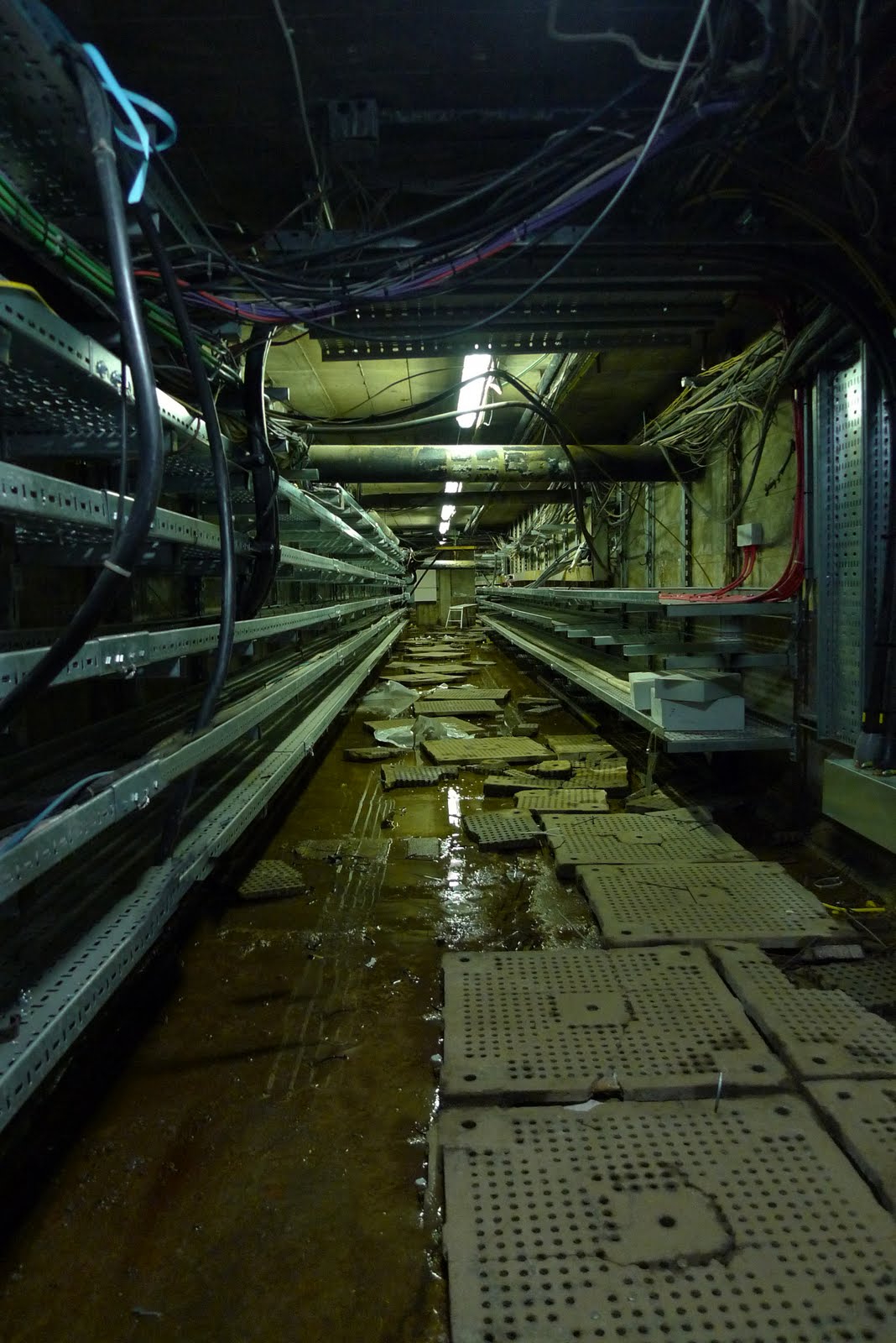
This tunnel runs all the way from the British Museum to Torrington Square, but is mostly inaccessible due to the current building works at the university. As we travelled further along the tunnel the sound of running water grew louder until finally we descended another ladder into a deeper tunnel from where the sound was emanating.  An extraordinary and haunting sight met my eyes - for here, beneath Senate House, was a large pool of water.

Water is flowing through a fissure in the wall and collecting on the floor.  The duck boards dotted along the tunnel serve as stepping stones and were placed there when the building was first constructed showing that the water was always present.   A channel two inches by two inches has been carved into the stone floor to allow the water to flow into a sump pumping the water up to The Moat above.
What lies beneath Senate House
 Below Senate House, water is flowing in from some mysterious source.  The water is constantly pumped out to prevent serious flooding. The pump keeps going and the water keeps coming back, but where is it coming from?


Please note: These tunnels are not open for public access.  Access was granted under special circumstances and the correct safety procedures were adhered to.